Assam's summers combine heat with heavy humidity, and that combination is hard on dogs. Heatstroke can develop within minutes and damage organs before it is obvious. Most cases can be prevented.
Why dogs overheat
Dogs barely sweat. They cool themselves mostly by panting, which works by evaporating moisture from the mouth and airways. In humid air evaporation slows, so panting cools a dog far less. Flat-faced breeds have narrow airways that make panting less effective still.
Exercise is the biggest risk
Hot cars get the attention, but a study of UK dogs under veterinary care found that about three in four cases of heatstroke followed exercise, while about one in twenty followed being shut in a vehicle. A walk, a run or a game of fetch in the heat of the day is the commonest trigger.
Dogs most at risk
- Flat-faced breeds: Pugs, Bulldogs, French Bulldogs and Shih Tzus
- Chow Chows and other thick-coated breeds
- Dogs over 50 kg, and dogs carrying extra weight
- Older dogs, and dogs with heart or breathing problems
The same UK research found that flat-faced and older dogs were also more likely to die when heatstroke struck.
Warning signs
- Heavy panting that does not settle with rest in the shade
- Thick drool
- Bright red or unusually pale gums
- Weakness, stumbling or reluctance to move
- Vomiting or diarrhoea
- Confusion, collapse or seizures
First aid: cool first, then go to the vet
The Royal Veterinary College advises cooling a dog before travelling, because every minute at a high temperature adds damage:
- Stop all activity and move your dog into shade or a cool room.
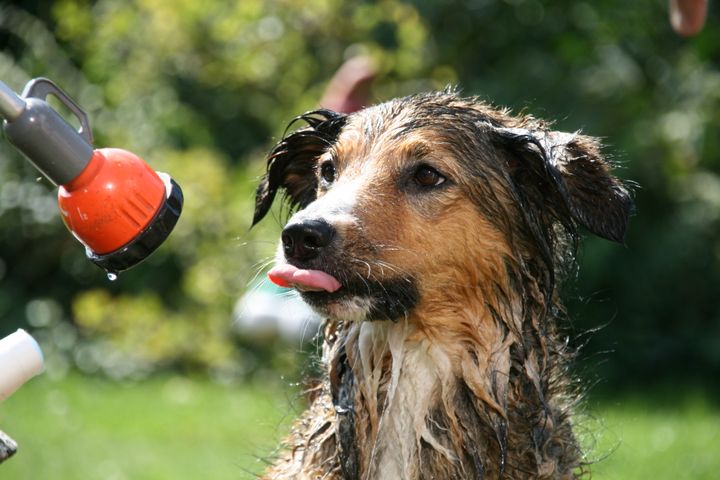
- Pour water over its whole body. Any water cooler than the dog helps; it does not need to be ice-cold. Keep the air moving with a fan or a breeze. A young, healthy dog can be put in a tub of cool water, with its head kept above the surface.
- Keep pouring and fanning. Do not lay a wet towel over the dog and leave it there; once the towel warms, it holds heat in.
- Offer small amounts of water if your dog is alert. Never force water into a weak or collapsed dog.
- As soon as the panting eases, take your dog to a vet, with the air conditioning on or the windows open. Heatstroke can damage the kidneys, the gut and blood clotting even when a dog seems to recover.
Prevention
- Walk early and late: before about 8 in the morning and after sunset. Skip long walks and games in the middle of the day.
- Test the road surface. If you cannot rest the back of your hand on it for several seconds, it is too hot for paws.
- Water everywhere: several bowls in shaded spots, refilled often, and water on every outing.
- A cool place to rest: shade, ventilation and a fan. A cooling mat helps.
- Never leave a dog in a parked car. The American Veterinary Medical Association notes that a car's interior can warm by about 11°C in ten minutes, and leaving the windows slightly open makes no difference.
- Keep your dog lean. Extra weight raises the risk.
Sources
- Hall, Carter and O'Neill (2020): Dogs don't die just in hot cars. Exertional heat-related illness is a greater threat to UK dogs
- Hall, Carter and O'Neill (2020): Incidence and risk factors for heat-related illness in UK dogs
- Risk factors for severe and fatal heat-related illness in UK dogs: a VetCompass study (2022)
- Royal Veterinary College: Cool first, transport second
- AVMA: Pet safety in vehicles
General information, not a diagnosis. If your pet seems unwell, contact a vet.